
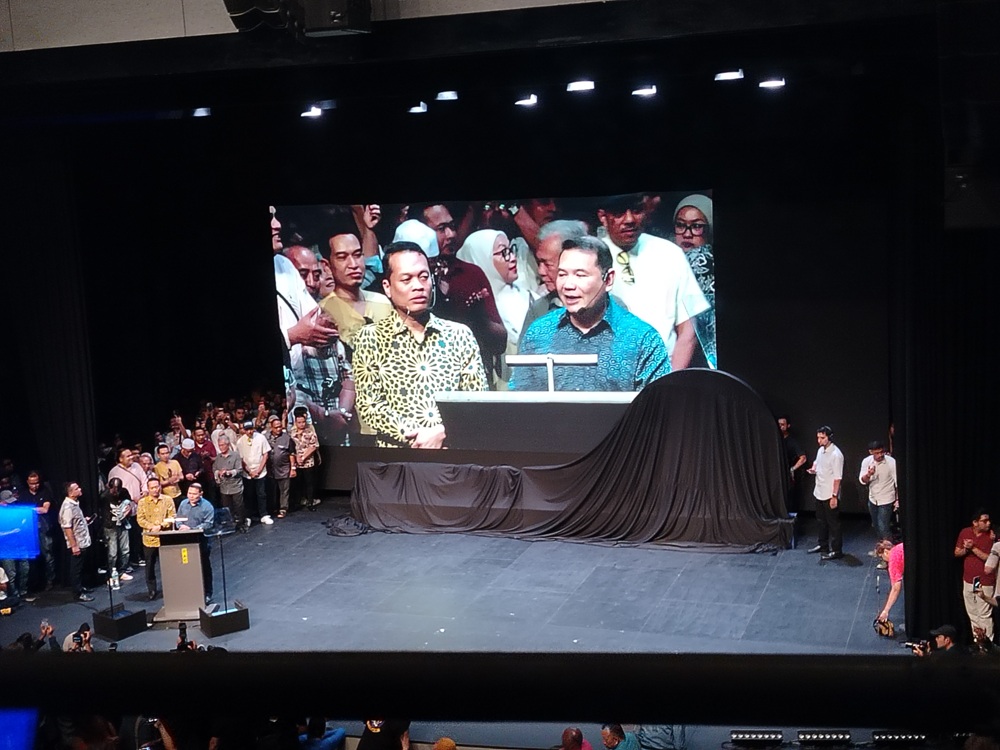
The launch of Parti Bersama Malaysia (Bersama) by Rafizi Ramli and Nik Nazmi Nik Ahmad may initially be dismissed as another splinter movement in Malaysia’s crowded political landscape. But doing so risks underestimating the deeper frustrations their new platform is attempting to capture.
What Rafizi outlined in his political declaration was not merely dissatisfaction with PKR or Pakatan Harapan. It was a broader critique of Malaysia’s entire post-2018 political order — one he argues has become trapped in transactional coalition politics, elite survival and ideological stagnation.
If Bersama succeeds in translating that frustration into a credible political movement, it could become one of the most consequential disruptors heading into GE16.
At the centre of Rafizi’s argument is a growing public exhaustion with what he described as “status quo politics”. Since 2018, Malaysia has experienced repeated coalition realignments where former rivals become governing partners after elections, often with little explanation beyond political necessity.
For many voters, especially younger Malaysians, this has created the perception that elections no longer produce meaningful policy change. Parties campaign aggressively against one another during elections, only to cooperate afterwards in government negotiations.
Rafizi framed this bluntly as a culture of “political dark lovers” — parties fighting publicly while privately preserving relationships to maintain power. Crude as the analogy may be, it resonates because it reflects widespread cynicism among voters who increasingly believe political alliances are driven less by principles than by arithmetic.
This is the political opening Bersama hopes to exploit.
Unlike traditional opposition narratives focused solely on corruption or ethnic mobilisation, Bersama appears intent on positioning itself as a generational and systemic alternative.
Rafizi repeatedly emphasised that the party is not fundamentally about personalities or ministerial positions, but about whether younger Malaysians still believe the country offers upward mobility, fairness and opportunity.
That message matters because it speaks directly to anxieties facing Gen Z and younger millennials.
Rafizi’s speech repeatedly returned to the idea that his generation grew up believing hard work, honesty and education would guarantee a better life. He contrasted that optimism with the realities confronting younger Malaysians today: rising living costs, wage stagnation, underemployment, political patronage and declining faith in meritocracy.
His argument was simple: younger Malaysians no longer feel confident that effort alone is enough to secure a future.
That critique cuts across race and class.
One of the more significant elements of Rafizi’s speech was his explicit warning that Malaysia cannot function effectively if large sections of society feel politically marginalised. He argued that non-Malay representation risks shrinking structurally over the coming decades as demographic and electoral changes reduce the number of non-Malay-majority constituencies.
Whether one agrees fully with that analysis or not, Bersama’s positioning is clear: it wants to become a genuinely multiracial political platform at a time when most major parties remain heavily trapped within ethnic political frameworks.
This could make Bersama especially attractive to urban mixed-seat voters who feel politically homeless — voters uncomfortable with ethno-nationalist rhetoric but equally disillusioned with Pakatan Harapan’s compromises and internal contradictions.
Another reason Bersama could matter politically is because Rafizi understands modern campaigning better than most Malaysian politicians.
He was among the earliest leaders to successfully combine data-driven campaigning, digital mobilisation and policy-oriented messaging. Even his critics acknowledge his ability to shape narratives online and connect complicated economic issues to everyday frustrations.
If Bersama can combine that strategic capability with credible younger candidates, crowdfunding and grassroots digital mobilisation, it may punch above its organisational weight despite lacking traditional machinery.
Importantly, Bersama does not necessarily need to win dozens of seats immediately to become influential.
Even a modest breakthrough in urban and semi-urban mixed constituencies could dramatically reshape electoral calculations for PH, BN and PN. In tightly contested seats, Bersama could emerge as a kingmaker, spoiler or catalyst for broader political realignment.
Its mere presence may force larger coalitions to compete more aggressively on governance, institutional reform and youth economic concerns rather than relying solely on racial polarisation or leadership personalities.
Rafizi himself acknowledged the possibility that Bersama may fail electorally. But he framed the effort as a necessary “kamikaze” mission designed to force a larger political reset.
That framing may sound dramatic, but it reflects an important truth about Malaysia’s political cycle. Since 2018, public trust in parties, coalitions and political institutions has steadily eroded. Many Malaysians no longer vote enthusiastically for parties they believe in; they vote defensively against outcomes they fear more.
Bersama’s gamble is that a growing number of Malaysians are ready to vote aspirationally again — not because they are certain the party will win, but because they want to disrupt a political system they increasingly see as exhausted.
Whether Bersama succeeds will ultimately depend on execution. Building a sustainable national party requires far more than speeches and symbolism. It needs local organisers, credible candidates, financial resilience and disciplined messaging over several election cycles.
But Rafizi’s speech revealed something important: Bersama is not trying to become merely another opposition party. It is attempting to redefine the political conversation around generational change, meritocracy, multiracial inclusion and the failure of coalition politics built purely around power-sharing.
In a fragmented political environment heading into GE16, that may be enough to make Bersama far more significant than many currently expect.



Leave a Reply