
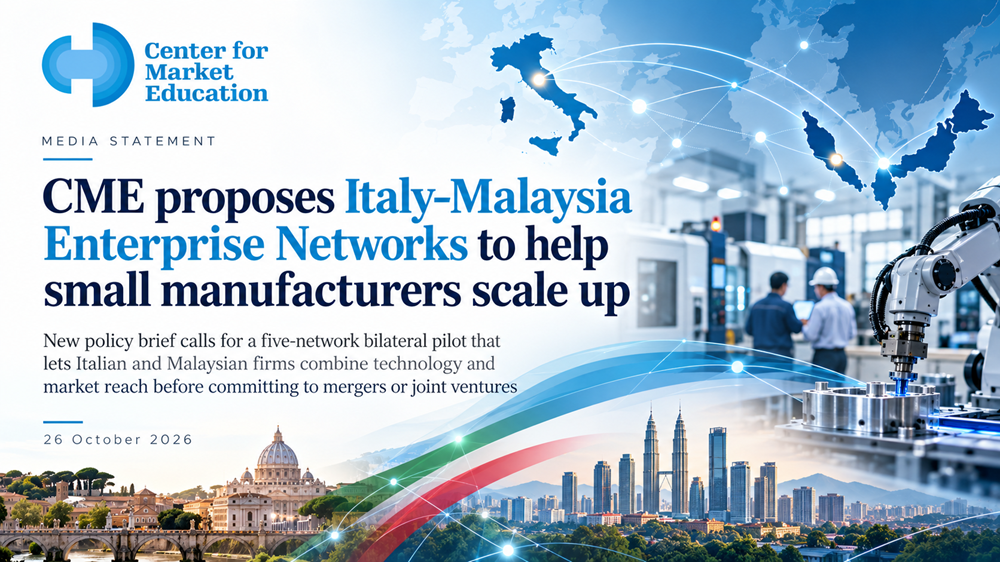
KUALA LUMPUR, 26 October 2026 – The Center for Market Education (CME) has proposed a new partnership model to help small and medium-sized manufacturers in Italy and Malaysia grow by working together while remaining independently owned.
In a new policy brief, From Fragmentation to Scale: Italy–Malaysia Enterprise Networks as a Framework for Entrepreneurial Consolidation, Innovation and Social Mobility, CME CEO Dr Carmelo Ferlito calls for an Italy–Malaysia Enterprise Network (IMEN) framework.
The proposal would allow Italian and Malaysian companies to share engineering, certification, production, export and after-sales services without having to merge or form a joint venture.
The idea is to help businesses combine their strengths, reach more customers and grow before making major long-term commitments.
The full policy brief is available here: https://marketedu.me/wp-content/uploads/2026/10/2026.10-From-Fagmentation-to-Scale-CME.pdf
Combining Italian technology with Malaysian market access
The brief argues that Italy and Malaysia can benefit from working together because their manufacturing industries have different but complementary strengths.
Many Italian small and medium-sized businesses have strong technical knowledge in specialised machinery, automation and engineering. However, they may not have the resources to maintain technical support and after-sales services across Southeast Asia.
Malaysian manufacturers, meanwhile, often have established links with Asian suppliers and customers, along with knowledge of regional markets and regulations. But some lack access to advanced design, production technology and specialised engineering.
By working together, the two sides could combine Italian technical expertise with Malaysian market knowledge and business networks.
Both countries also face a similar challenge: most businesses are small, while relatively few grow into large private companies.
In Italy, businesses with at least 250 employees generate EUR 84,200 in value added per worker, compared with EUR 38,500 in microenterprises.
In Malaysia, workers at large companies earned an average of 47.5 per cent more than those working in micro, small and medium-sized enterprises (MSMEs) in 2023.
CME argues that helping smaller businesses grow could also improve career opportunities, training and employee benefits.
Malaysia’s small-business gap
Malaysia’s 2023 Economic Census recorded 1,069,831 MSME establishments employing 6.5 million people. Yet these businesses contributed only 39.7 per cent of gross domestic product (GDP) and 14.7 per cent of exports.
By comparison, large companies, which made up about 2 per cent of establishments, accounted for 62.64 per cent of output in 2021.
The brief notes that many of Malaysia’s largest companies are government-linked, raising questions about how to encourage more private businesses to grow into larger and more competitive enterprises.
CME said the aim is not to replace small businesses or create new state-backed conglomerates. Instead, it wants to make it easier for successful private businesses to expand, hire more workers and compete internationally.
“The jump from a supplier relationship to a merger or joint venture is too large for many firms,” Dr Ferlito said.
“An enterprise network lets them test whether Italian technology and Malaysian market position create more value together before anyone makes an irreversible commitment. The network lowers the cost of finding out.”
Building on Italy’s experience
Italy introduced the contratto di rete, or network contract, in 2009. It allows independent companies to work together on agreed business goals while keeping their own ownership and legal identity.
Companies can share technology, technical staff, purchasing, logistics and export services without combining their businesses.
By 2025, Italy had 10,361 active network contracts involving about 53,000 businesses, an increase of 7.6 per cent from the previous year.
A study by Confindustria and Italy’s National Institute of Statistics (ISTAT) found that, three years after joining a network, participating companies recorded revenue growth 14.4 percentage points higher than similar businesses outside the programme. Their employment growth was 11.2 percentage points higher.
However, the brief cautions that the results should be interpreted carefully. The study covered Italy’s 2011–2014 recession, when network firms also performed better partly because they contracted less than comparable businesses. Results also differed across industries.
CME’s proposal would extend the network model across national borders, building on earlier research by Ferlito and co-authors on business networks as a way to help Malaysian companies grow.
Five networks to test the model
CME recommends starting with five pilot networks, each involving about eight companies: four Italian and four Malaysian.
The longer-term goal would be to establish ten networks as a successful first phase.
Each network would focus on a clear business objective that could be measured over three to five years.
Possible projects include helping a Malaysian supplier meet Italian technical standards, adapting an Italian product for Southeast Asian markets, developing a new component or setting up shared engineering and after-sales services.
Companies could also work together on product testing, certification or bids for customers that neither business could serve alone.
CME said starting with a small number of networks would allow the partners to assess whether companies are well matched, whether intellectual property is properly protected and whether shared resources are being used effectively.
The pilot would also test whether businesses choose to deepen their partnerships without relying on permanent government subsidies.
The brief notes that Italy took 16 years to build its network system and that only about 150 Italian companies currently operate in Malaysia.
Four industries identified for the pilot
CME identifies four sectors as possible starting points for the programme:
-
- Industrial machinery and automation: Malaysia’s demand for imported machinery could match Italy’s expertise in specialised equipment and automation.
-
- Engineering support industries: Malaysian businesses in precision machining, moulds, tooling, casting and fabrication could benefit from advanced Italian production methods.
-
- Valves, tubulars and energy equipment: Italian industrial expertise could complement Malaysian demand from the oil, gas and petrochemical industries.
-
- Packaging and food-processing technology: Italian technology could support Malaysia’s growing food and beverage industry and its wider regional market.
These sectors would not receive exclusive access to the programme. Companies from other industries could also participate if they presented a clear business plan for cooperation.
A market-led approach, not government control
Under the proposed framework, networks would have to include at least four independent companies from both countries and commit to a three- to five-year programme involving at least two shared business functions.
These could include joint research and development, common certification, coordinated manufacturing, shared export channels or regional after-sales services.
Each network would appoint a coordinator, establish clear voting rules and agree on how to protect intellectual property and confidential information. Contracts would also cover the admission of new members, withdrawal and dispute resolution.
CME suggests that any tax incentive should be temporary, lasting three years, and apply only to profits reinvested in the shared network programme.
The framework would not provide preferential access to government contracts, protected markets or exemptions from competition rules.
Companies could eventually establish joint ventures, take equity stakes in one another or merge. They could also continue working under their original contracts or dissolve the network.
The brief identifies ItalCham Malaysia and the Federation of Malaysian Manufacturers as potential partners to bring companies together.
It also calls for practical measures to reduce the cost of cross-border cooperation, including simpler procedures for moving prototypes and testing equipment, recognised documents for technical staff, access to accredited testing laboratories and digital customs processing.
Participating companies would share anonymised data before and after joining the programme so that its results could be measured.
“Firms must be free to grow, cooperate and merge where efficiency and innovation reward them,” Dr Ferlito said.
“But size should never become a shield against future competition. What we want is concentration without closure: scale earned through market discovery, not privilege.”
Trade pressures make cooperation more urgent
CME said growing competition from China, continued US tariff measures and renewed negotiations on a Malaysia–European Union Free Trade Agreement (MEUFTA) make closer industrial cooperation increasingly important.
The European Central Bank has documented a sharp increase since 2019 in the overlap between Chinese and European exports, particularly in machinery and transport equipment.
The brief argues that Italian and Malaysian manufacturers should respond by diversifying their markets and business partnerships rather than relying on protectionist measures.
A future Malaysia–EU trade agreement could also make cooperation easier. Its proposed areas of coverage include market access, customs, rules of origin, technical standards, investment and intellectual property.
CME argues that businesses that establish networks while negotiations continue could be better prepared to benefit from improved trade arrangements in the future.
Modest gains expected from the pilot
The brief includes estimates of the possible economic benefits if the pilot succeeds, using only half of the historical gains reported for Italian business networks.
Under this assumption, a five-network pilot could generate an additional EUR 840,000 in Italian turnover, RM1.71 million in Malaysian output and around ten additional jobs after three years.
If the programme eventually expands to 100 networks involving 400 companies from each country, the same calculation suggests an additional EUR 16.7 million in Italian turnover, RM34.3 million in Malaysian output and about 204 additional jobs.
These estimates do not include possible wider benefits, such as stronger supplier networks, the transfer of technical knowledge or future mergers and joint ventures.
CME stresses that the figures are estimates rather than guaranteed results. The pilot’s main purpose is to test whether the model works in practice before expanding it.
The brief’s central message is that Italy and Malaysia should give independent manufacturers a practical way to grow together, share expertise and reach new markets without forcing them into mergers or long-term commitments too early.
CME argues that if the pilot produces clear results, the programme could offer a new way to help more private businesses grow into larger, more productive and internationally competitive companies.
https://marketedu.me/wp-content/uploads/2026/10/2026.10-From-Fragmentation-to-Scale-CME.pdf







Leave a Reply