
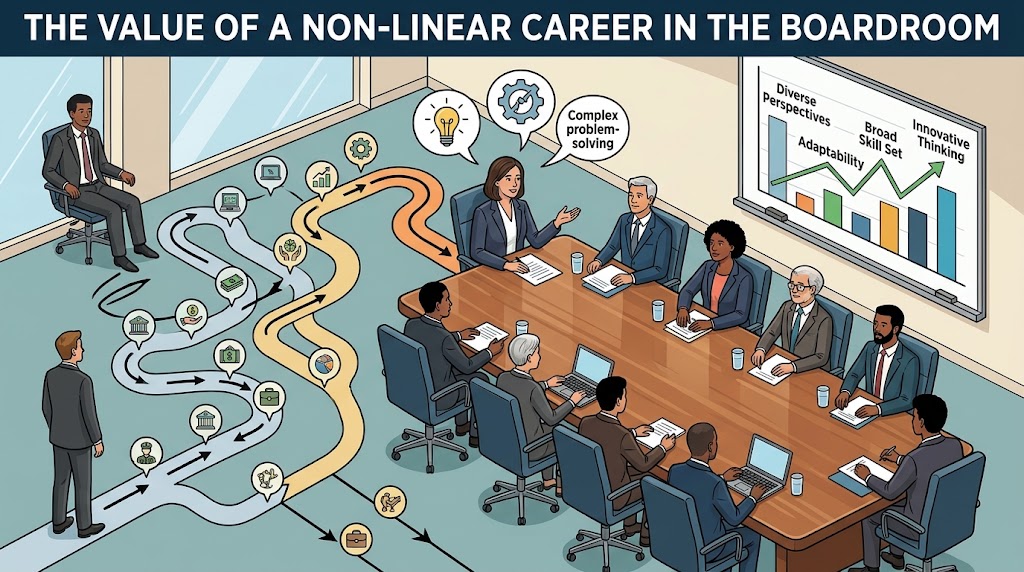
Career progression is often presented as a straight line: choose a profession, develop expertise, move into management, take on greater responsibility and eventually reach the boardroom. But the reality is that many senior leaders arrive there by taking very different routes.
Some build their careers through deep specialisation, while others move across functions, industries, markets and even countries. Neither path is inherently superior. Yet there is something increasingly valuable about a career that does not follow a conventional trajectory: perspective.
Over more than three decades, my own career has taken me through finance, management consulting, advertising, technology, telecommunications, entrepreneurship and strategic communications. It has also taken me beyond Malaysia, including expatriate assignments in Cambodia and the UK. At different points, these experiences may have appeared disconnected.
With hindsight, however, they have shaped how I think about business, people, markets, risk and decision-making. The real value has not been simply in having a long or varied CV. It has been in learning how different parts of the business world connect.
One of the experiences that stands out was my move to Cambodia. When I arrived in Phnom Penh for a senior telecommunications role, I knew no one. The country was still emerging from significant instability and the office was, quite literally, bulletproof and bombproof. Yet I remember the city as beautiful and its people as remarkably resilient and determined to move forward.
The professional environment was equally different from what I had previously known. Consumer behaviour was different, market conditions were different and established assumptions did not necessarily apply. We had to find new ways to reach customers and learned very quickly that taking away someone’s telephone line could become a rather serious customer-relations issue.
It was an early reminder that business decisions cannot be separated from context. What works in one market may not work in another, and what appears straightforward from a headquarters perspective can look very different on the ground.
That experience subsequently opened another unexpected door. My telecommunications work in Cambodia caught the attention of investors in the UK, leading to an opportunity to become Managing Director of a UK-based auction technology start-up.
The role brought responsibility for commercial strategy, people, growth and P&L, while operating across international markets. We raised significant capital, built the business and, along the way, sold some fascinating things — including, rather memorably, John Lennon’s piano.
Entrepreneurship has a way of stripping strategy down to its essentials. Revenue, costs, investment, people, risk and execution cannot be treated as separate conversations when you are responsible for the business.
A strategy may look compelling on paper, but ultimately it has to work in the real world. That lesson has stayed with me through 22 years of building and evolving my own consultancy, from conventional PR and communications into strategic communications, reputation and stakeholder advisory, executive engagement and work with senior management and boards.
Today, the value of those different experiences increasingly comes together in my advisory work. In one recent engagement, I worked with leaders identified as their organisation’s next generation of board-level talent.
The challenge was not simply to add another technical skill. It was to make a fundamental shift in perspective: from managing a function to understanding the enterprise as a whole.
That means recognising that strategy, people, risk, stakeholders, reputation and long-term value are rarely separate issues. A financial decision can have reputational consequences. A technology decision can affect people and culture.
A regulatory development can quickly become a stakeholder issue. An operational decision can ultimately influence enterprise value. At board level, the important questions rarely sit neatly within one organisational function.
This is where a non-linear career can become particularly useful. The contribution of a board member is not necessarily to have the answer to every question. Sometimes it is to ask the question that has not yet been considered.
Sometimes it is to challenge an assumption. Sometimes it is to recognise a connection between seemingly unrelated issues because previous experiences have provided a different reference point.
That perspective can matter because board discussions are ultimately about judgement. The ability to understand competing considerations, identify patterns and see beyond an individual issue can influence the quality of a conversation and, consequently, the decisions that follow.
Of course, breadth should never be confused with expertise. Deep knowledge remains essential, particularly in an increasingly complex business environment. The value comes when breadth and depth complement each other. Experience across different functions, industries and markets can provide context and pattern recognition; deep expertise provides the substance on which sound decisions can be built.
Perhaps that is the real value of a non-linear career. It is not the number of industries listed on a CV, nor the novelty of having taken an unconventional path.
It is what those experiences can develop over time: perspective, context, pattern recognition and the ability to connect the dots.
In the boardroom, where decisions rarely exist in isolation, those connections can be significant. Sometimes the dots only become visible because you have travelled a few different roads to get there.
In a compelling commentary, Hazlina Hashim, Executive Director of Hazel Green PR and Chairman of Women in PR, emphasizes the critical role of strategic communications and empowering female leadership in shaping resilient, authentic brand narratives in today’s evolving industry landscape.







Leave a Reply