
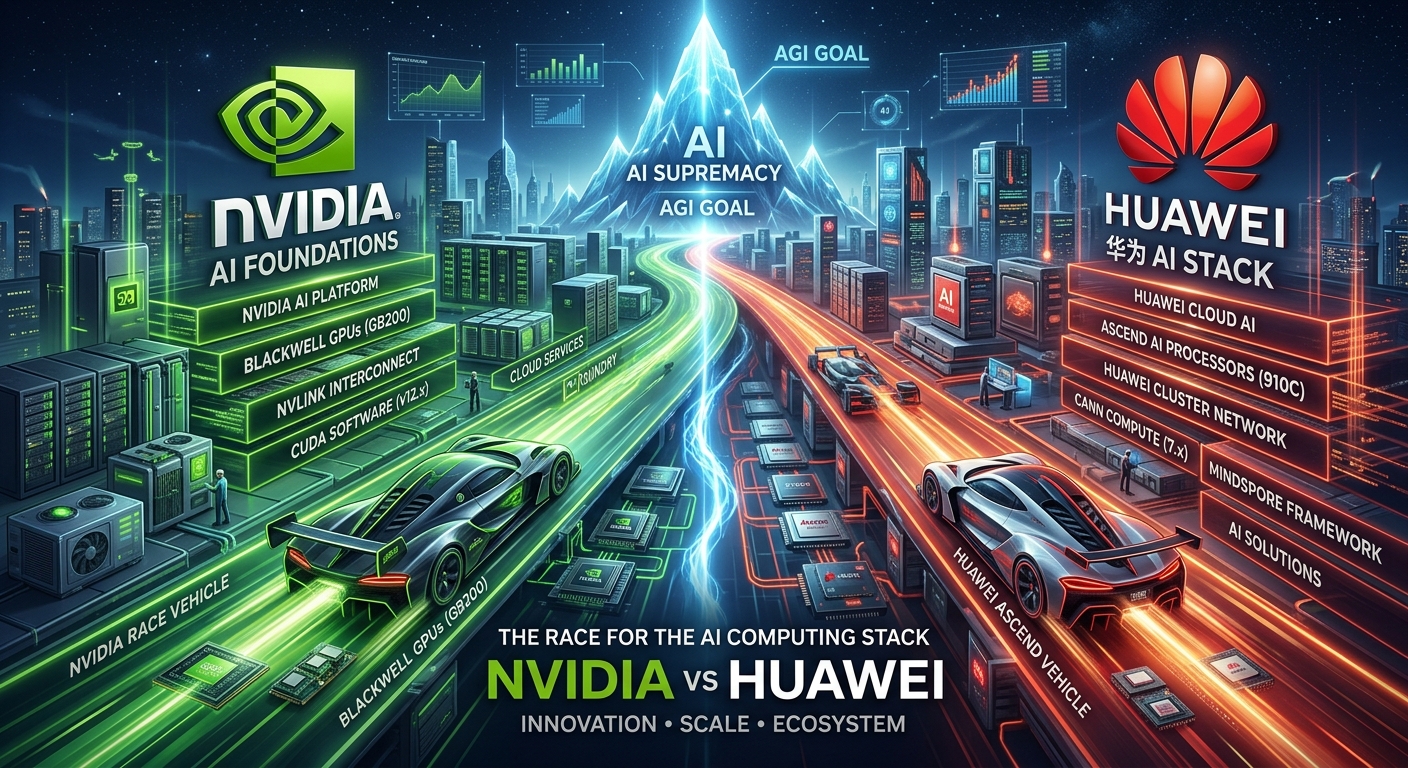
The competition between NVIDIA and Huawei is becoming about more than who can build the fastest AI chip. It is increasingly a race to control the broader computing infrastructure that will power the next generation of artificial intelligence.
NVIDIA has built its position around a combination of high-performance GPUs, networking, software and developer tools. Its strength is not simply the processor itself, but the ecosystem surrounding it. For companies building large AI systems, the ability to connect thousands of processors, optimise workloads and deploy models efficiently can be just as important as raw chip performance.
Huawei is pursuing a different but increasingly significant path. Facing restrictions on access to some advanced U.S. semiconductor technologies, the Chinese technology giant has been developing its own Ascend processors and expanding into complete AI computing systems. Its latest Atlas 960 SuperPoD announcement shows that Huawei is looking beyond individual chips and toward larger-scale AI infrastructure.
That makes the competition particularly interesting. NVIDIA is trying to extend its technological and commercial lead globally, while Huawei is helping China build an alternative AI computing ecosystem that is less dependent on American technology. The two companies are therefore competing not only on silicon, but also on infrastructure, software, engineering expertise and customer ecosystems.
The geopolitical dimension adds another layer to the race. U.S. restrictions on advanced semiconductor technology have made access to cutting-edge AI hardware a strategic issue for China. Instead of simply limiting China’s ability to acquire certain chips, the restrictions have also created an incentive for Chinese companies to develop domestic alternatives.
Huawei’s challenge should therefore be viewed in the context of China’s much broader push for semiconductor and AI self-reliance. The company does not necessarily need to replicate NVIDIA’s global business model to have an impact. Building a strong domestic ecosystem could give Huawei a substantial customer base and provide Chinese companies with an alternative platform for developing and deploying AI.
For NVIDIA, the challenge is equally strategic. Maintaining leadership will increasingly require more than delivering powerful processors. AI customers are looking for complete systems that can scale, run efficiently and support increasingly complex models. The company’s software ecosystem and relationships with cloud providers and developers remain important parts of that equation.
The interesting question is therefore not simply whether Huawei can produce a chip that matches an NVIDIA processor on a particular benchmark. The bigger question is whether Huawei can build an ecosystem around its hardware that is sufficiently capable, scalable and widely adopted to become a credible alternative within China and potentially beyond.
This is why the NVIDIA-Huawei contest could become one of the defining technology races of the AI era. It brings together semiconductor engineering, software, cloud infrastructure, supply chains and geopolitics. The winners of this race will not necessarily be determined by a single chip generation, but by who can build the most sustainable AI computing ecosystem.
For businesses, that competition could ultimately create both opportunities and challenges. More competing AI platforms could give customers greater choice and reduce dependence on a single technology ecosystem. At the same time, companies operating across markets may increasingly have to navigate different AI hardware and software ecosystems shaped by technology restrictions and geopolitical realities.
The AI chip race is no longer just about chips. It is becoming a race over who gets to build the infrastructure on which the AI economy runs.







Leave a Reply