
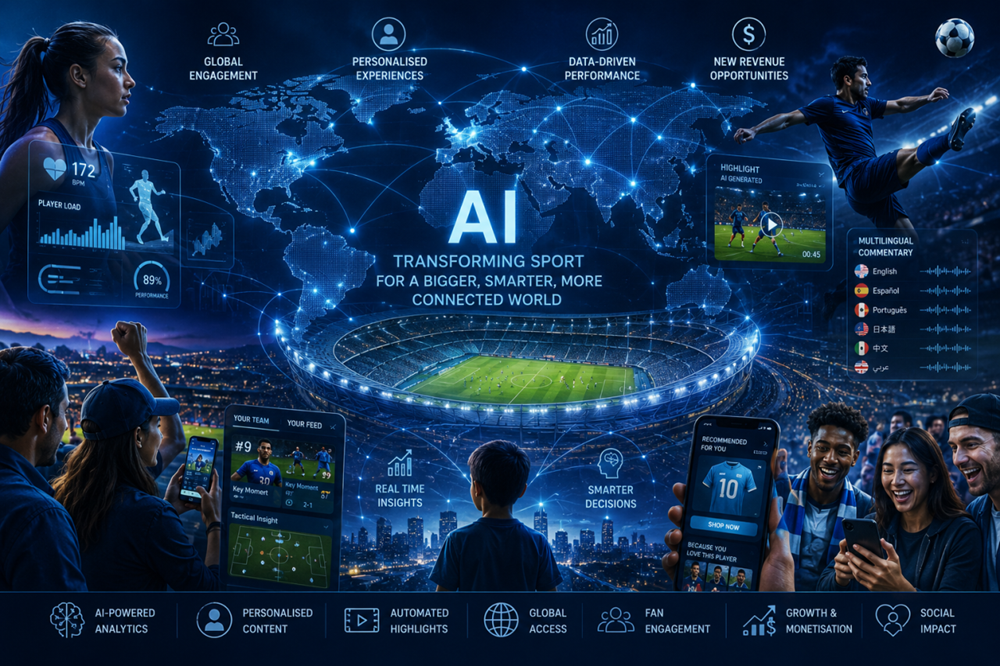
Sport is entering a new era. One not defined solely by athletic performance, but by intelligence.
Artificial intelligence is no longer a supporting tool in the background, instead it is becoming the system through which sport is played, experienced, managed and monetised.
Across the global sports landscape, the direction is unmistakable. Over 80% of sports organisations are already using AI, and nearly all are increasing their investments.
Around three-quarters report measurable value from their AI initiatives. What was once experimental is now essential. Sport, in many ways, is beginning to resemble the world of big technology: data-rich, platform-driven, and powered by algorithms.
But this transformation is not just about efficiency. It is about reinvention.
“Over 80% of sports organisations already use AI and nearly all are increasing their investment.”
- From Matches to Experiences
For decades, sport was defined by moments. Kick-off, final whistle, highlights on the evening news. Today, those boundaries are dissolving.
AI is accelerating a shift from event-based consumption to continuous engagement. Matches are no longer the only product. Instead, sport is becoming an always-on experience, tailored to each individual fan.
A supporter can now receive a personalised stream of content: highlights of a favourite player, real-time statistics explained in simple terms, or even alternative camera angles and commentary styles selected on demand.
Platforms like YouTube have become central to this ecosystem, serving as both broadcasters and engagement hubs.
AI-generated highlightes can be produced within seconds of a sport event, edited and distribute across platforms without human intervention. Automated multilingual commentary means a fan in São Paulo can receive the same moment in Portuguese that a fan in Tokyo receives in Japanese, simultaneously and without delay.
This is not just more content, it is smarter content. AI can transform raw data into stories, turning numbers into narratives that deepen emotional connection.
In this new environment, storytelling is no longer limited by human production capacity. It can happen instantly, at scale, and in multiple languages.
‘It was always about the Fan’
We have always known that sport derives its power from emotional connection and for the first time, AI is making it possible to honour that connection at every moment, not just at kick-off. We are now able to bring fans closer to the sport they love than ever before. The best is yet to come, and we are just getting started.
- The Acceleration of Personalisation
At the heart of this transformation lies personalisation. Increasingly, sport can be delivered as a unique experience for every individual. The same match can look completely different depending on who is watching it, what they care about, how they prefer to consume content and where they are in the world.
This extends beyond media. E-commerce, Fan Engagement, and even in-app interactions are becoming more personalised. AI allows organisations even more to deliver the right message, to the right person, at the right time, on the right platform.
Hyper-personalised content. Your player, your feed, your highlights is rapidly becoming the standard expectation rather than a premium feature.
Conversational AI Tools are already providing real-time context during matches, explaining a referee’s decision or the tactical significance of a substitution at exactly the moment a fan needs it.
And yet, despite its potential, personalisation remains underutilised. Only about one in four sports organisations has fully implemented personalisation. This gap represents one of the biggest opportunities in the industry today.
“Only 1 in 4 sports organisations has fully implemented personalisation. One of the biggest untapped opportunities in the industry.”
- A New Engine for Growth
Historically, technology in sport was seen as a cost. Necessary, but rarely transformative. That perception is changing rapidly.
AI is turning technology from a cost centre into a driver of revenue. Enhanced media experiences are increasing the value of media rights. Direct-to-consumer platforms are strengthening relationships between organisations and fans.
New digital environments, ranging from interactive platforms to gaming ecosystems like Roblox and Fortnite, are opening entirely new channels for engagement and monetisation. Data-driven sponsorship and advertising are enabling brands to reach highly targeted audiences with a precision that traditional media could never offer.
Fan engagement is also evolving in a deeper sense: the relationship is shifting from transactional to relational, from reaching audiences to building communities.
Interestingly, not all value is immediate or transactional.
More content, more interaction and more touchpoints are often serving a deeper purpose: building loyalty.
In this sense, AI is not just generating revenue, it is sustaining it over time.
‘Engagement has become the product’
The shift we see happening is that for most of its history, sport has measured commercial success through transactions.
Tickets sold, memberships renewed, merchandise moved, sponsor deals made and broadcast deals closed. But the organisations pulling ahead are those thinking like media companies, building audiences before building revenue models. Engagement is not the path to monetisation, it is the product, and revenue follows loyalty.
- Beyond the Spotlight- Transforming the Core of Sport
While fan facing innovation is the most visible change, AI’s impact runs much deeper.
Behind the scenes, it is transforming operations. Scheduling, logistics, and event planning are becoming more efficient through predictive systems.
Automated decision-support tools are assisting referees and judges, improving the accuracy and consistency of officiating in ways that reduce controversy and protect the integrity of outcomes.
On the field of play, AI is enhancing both performance and fairness. Athletes and coaches have access to real-time feedback powered by video and sensor data.
Biomechanical analysis can now detect patterns in a young athlete’s movement that would have been invisible to the human eye, identifying talent earlier and more accurately than traditional scouting methods. What were once called ‘invisible skills’: spatial awareness, decision-making speed and off-ball movement can now be quantified and developed through AI-assisted training tools.
At the same time, AI is playing a growing role in protecting the integrity of sport. It can identify suspicious patterns in competition and betting activity, detect online abuse directed at athletes and monitor risks that would be impossible to track manually.
It is also contributing to athlete wellbeing, from injury prevention through workload management to the early detection of mental stress before it becomes a crisis.
‘In Pursuit of the Purest Game’
Sport’s greatest promise has always been a simple one. That the best team wins, the most talented athlete succeeds, and the outcome is decided on merit alone.
We now have the tools to make that promise more achievable than ever, identifying talent wherever it exists, optimising performance with a precision and effectiveness that was previously unimaginable, and detecting threats to integrity before they can take hold.
We are closer than we have ever been to sport in its trust and most effective form. Fairer in its outcomes, sharper in its development, and better protected than at any point in its history.
- The Democratisation of Expertise
One of the most profound impacts of AI is its ability to lower barriers to entry.Tools that were once available only to elite teams are becoming accessible to grassroots athletes and coaches. A simple smartphone can now provide technical feedback, performance analysis, and training insights that previously required a full analytics department to generate.
This has the potential to reshape global sport development. Countries and communities with fewer resources can access knowledge and capabilities that were previously out of reach. A coach in a low-income region can use AI-powered video analysis to provide their athletes with the same quality of biomechanical feedback that professional athletes receive.
Scalable coaching tools are beginning to narrow the gap between high- and low-resource environments in ways that could, over time, lead to a more diverse and globally representative talent pipeline and a more level playing field.
The democratisation of expertise is not just a social good; it is a commercial opportunity, opening sport to billions of new participants and fans around the world.
‘Elite knowledge just lost its address’
The world has almost certainly missed generations of athletes who simply never had access to the right tools, coaches or opportunities.
AI is changing that by placing world-class knowledge and development capabilities in the hands of anyone with a smartphone, regardless of where they live or what their club can afford.
The playing field is not yet level, but for the first time, we have the means to make it so, and the opportunity that unlocks for sport, for communities, and for the world is extraordinary.
- A New Kind of Intelligence: Agentic AI
Looking ahead, the next phase of transformation is already emerging. AI is evolving from a tool that supports decisions to one that can make decisions autonomously. This is often referred to as agentic AI. In the future, AI systems may act on behalf of fans, athletes and organisations curating content, managing operations and even negotiating outcomes with other systems.
Fan assistants will curate entire event-day experiences, from pre-game content to post-game analysis without any human editorial involvement. Operational systems will self-optimise adjusting stadium staffing, broadcast delivery and merchandise logistics in real time based on demand signals.
Commercial processes, including sponsorship activation and advertising placement, will become increasingly automated.
These agent-to-agent interactions will redefine the digital architecture of sport. A fan’s personal AI assistant may one day negotiate the best ticket price with a club’s automated sales system, simultaneously booking transport, ordering food, and selecting the optimal seat based on the fan’s preferences all before the fan has consciously decided to attend.
But this shift also introduces new responsibilities. Questions around bias, transparency and control become more urgent when decisions are made at scale and at speed. Ensuring that these systems are trustworthy, explainable, and subject to meaningful human oversight will be critical.
- Sport Meets Gaming and Betting: A Converging Landscape
The traditional boundaries between sport, entertainment, gaming and wagering are no longer clearly defined. They are blurring and, in some cases, dissolving entirely.
Gaming platforms like Roblox and Fortnite have become legitimate fan engagement spaces, attracting audiences that include millions of young people who may never attend a live sport event but interact with sport brands and athletes daily through virtual environments.
For sports organisations, these platforms represent both an opportunity and a challenge: a way to reach the next generation of fans, but on terrain that requires new competencies and new commercial models.
The betting landscape is undergoing an equally significant transformation. AI-powered wagering experiences now resemble real-time data trading environments, where the odds update dynamically with every pass, tackle or serve.
Conversational AI-interfaces guide users through increasingly complex data, explaining probabilistic outcomes and enabling in-play decision-making at a pace that was unimaginable a decade ago.
However, these developments come with serious responsibilities.
AI-driven betting environments carry real risks of addiction and harm, particularly when personalisation is used to identify and target vulnerable users.
Sports organisations, technology providers and regulators face an urgent need to establish governance frameworks that protect consumers while allowing legitimate innovation to proceed.
Integrity monitoring is also a growing priority: AI systems that can detect suspicious betting patterns in real time are becoming an essential tool for protecting the credibility of competition.
Despite the scale of the opportunity, many organisations still lack a coherent strategy in this space. The gap between the pace of change and the readiness of institutions to respond to it remains one of the defining challenges of the current period.
- Smart Venues and the Future of Live Sport
The stadium, for more than a century the unchanging heart of the live sports experience, is being reimagined.
It is evolving from a passive infrastructure into an active, intelligent environment. AI-powered systems are transforming how venues operate in real time.
Crowd flow algorithms predict bottlenecks before they form and reroute fans dynamically, reducing queues and improving safety.
Food and beverage services are optimised based on demand forecasting, cutting waste and improving service speed. Navigation systems guide fans to their seats via the least congested route, updating in real time as conditions change.
The concept of the digital twin is also transforming venue planning and event management. Entire stadiums and arenas can now be simulated in virtual form before a single fan arrives, or even before a single brick is laid.
These simulations allow operators to model crowd behaviour, test emergency scenarios, optimise sightlines and plan service delivery with a level of precision that was previously impossible.
Beyond operations, AI is enabling entirely new categories of live experience. Immersive technologies like augmented and virtual reality, real-time data overlays and spatial audio are beginning to merge with the physical environment of the stadium.
Emerging concepts such as shared reality environments are creating experiences where the boundary between being physically present and watching from a distance becomes less distinct.
The future stadium may not require physical presence at all: fans at home may eventually have access to a live-sport experience that is experientially comparable to being in the stands.
“The Stadium That Thinks Ahead’
The live stadium experience is being reinvented from the ground up. Smarter venues that anticipate your needs, remove the friction, and wrap every moment of the matchday in an experience that feels effortless and personal.
The stadium is becoming an intelligent host, ensuring that from the moment you arrive to the final whistle, every detail works in your favour. The game has always been worth showing up for and now, everything around it is too.
- The Human Factor
Despite all the technological progress, one truth remains: the biggest challenges are not technical, they are human.
Organisations face barriers such as legacy systems, skill gaps and internal resistance to change.
Leadership alignment is often the deciding factor between success and stagnation.
The transformation AI demands is not primarily one of infrastructure, it is one of culture, mindset and strategy.
The stakeholders required to drive this change span every function of a sports organisation. Executives must set the vision and direct investment. Product and strategy teams must build AI-driven offerings that genuinely serve fans and athletes.
Marketing and media teams must adapt to new engagement models. Data and technology teams must enable the infrastructure and the insights. Finance teams must validate business cases and demonstrate return on investment. When these functions are aligned around a common AI strategy, progress can be rapid. When they are not, even the best technology will fail to deliver value.
AI adoption requires more than investment. It demands a shift in mindset, culture and strategy. It requires executives to understand not just what AI can do, but how it will reshape their entire business model.
“The gap between ambition and outcome in AI is almost always human.”
- Balancing Innovation and Responsibility
As AI becomes more deeply embedded in sport, the importance of responsible use cannot be overstated.
Data privacy, consent and transparency must form the foundation of every system.
Athletes, in particular, must remain at the centre of this transformation with their rights and wellbeing protected at all times. The principle of athlete-first AI governance is not simply an ethical aspiration, it is a commercial and reputational imperative. Organisations that fail to protect their athletes risk losing trust, talent and ultimately their social licence to operate.
There is also a need to guard against risks such as bias, manipulation and misuse. AI systems trained on historical data can inadvertently encode and amplify existing inequalities for example in talent identification, in officiating or in the distribution of resources. Maintaining human oversight (keeping humans meaningfully in the loop) is essential to ensuring that AI enhances sport without compromising its integrity.
The four strategic pillars that will define successful AI adoption: ‘Efficiency, Engagement, Inclusiveness and Sustainability’ must all be pursued within a framework of integrity and athlete health. These are not constraints on innovation; they are the conditions that make innovation sustainable.
- A New Era of Sport
Sport is no longer just competition. It is increasingly a connected, intelligent and personalised ecosystem. The traditional boundaries between live events, media, technology and entertainment are dissolving. Broadcasting and streaming are converging. Gaming, social platforms and sport are blending into unified experiences.
Advances in connectivity like 5G, 6G and satellite networks will accelerate this shift even further, enabling real-time experiences in environments where reliable connectivity was previously unavailable. What emerges is a new model of sport.
One built on three pillars:
- Deeper fan engagement that drives revenue growth;
- Enhanced athletic performance that drives competitive success; and
- Greater operational efficiency that controls
Together, they define a system where AI is not an add-on, but the foundation.
The Bottom Line
AI is shifting sport from a product to a system. And that changes everything. Organisations that act with urgency, think strategically and embrace responsible innovation will lead this new era.
Those that hesitate risk losing relevance in a world where expectations are evolving rapidly and the pace of change shows no sign of slowing.
The future of sport will not just be played on fields or courts. It will be shaped by data, driven by intelligence and experienced in ways we are only beginning to understand.
The organisations that will thrive are those that recognise AI not as a technology project, but as a strategic transformation. One that touches every part of how sport is created, delivered, experienced, and monetised.
“AI is now central to the future of sport and to staying relevant in a rapidly changing global landscape.”
About Sports Cloud Australia
Sports Cloud Australia sits at the intersection of sport, data and commercial strategy.
Helping sports organisations navigate the AI era with clarity, confidence and a deep understanding of what makes sport unique.
We are not just observers of the transformation described in this whitepaper, we are active partners in it working alongside sports organisations of every kind across the world to turn these opportunities into reality.
Check out their website — https://sportscloudaustralia.com/






Leave a Reply