
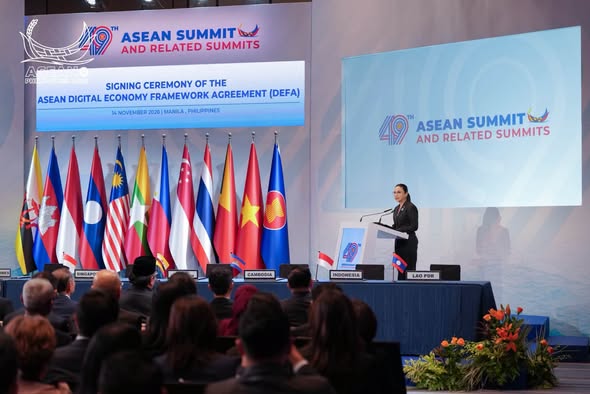
MANILA – ASEAN Member States have signed the landmark ASEAN Digital Economy Framework Agreement (DEFA), marking a major milestone in the region’s efforts to strengthen digital integration, expand business opportunities and deepen economic partnerships.
The agreement was signed during the 28th ASEAN Economic Community Council (AECC) Meeting in Manila, the Philippines, attended by Singapore Deputy Prime Minister and Minister for Trade and Industry Gan Kim Yong and his ASEAN counterparts.
As ASEAN’s first standalone, legally binding digital economy agreement, DEFA aims to establish a more integrated and seamless digital market across the region.
The agreement covers key areas including cross-border data flows, end-to-end digital trade, source code protection, cybersecurity and artificial intelligence (AI). It seeks to improve interoperability and facilitate cross-border business operations, particularly in technology, e-commerce, digital payments, logistics and supply chains.
Micro, small and medium-sized enterprises (MSMEs) are expected to benefit from improved opportunities to expand their businesses and access ASEAN’s growing digital economy.
Beyond digital integration, ASEAN leaders also made progress on several key economic initiatives aimed at strengthening regional resilience and diversifying international partnerships.
These include advancing negotiations on the ASEAN–Canada Free Trade Agreement (FTA) towards a substantial conclusion, which is expected to be announced by regional leaders. The agreement would mark ASEAN’s first FTA with North America, with full conclusion and signing targeted for 2027, coinciding with the 50th anniversary of ASEAN–Canada Dialogue Relations.
ASEAN is also reviewing and upgrading its existing FTAs with the Republic of Korea and India, while exploring a potential new trade agreement with the Gulf Cooperation Council (GCC).
On regional connectivity, ASEAN formalised an enhanced Memorandum of Understanding (MoU) on the ASEAN Power Grid (APG), signalling a shift towards implementing cross-border electricity connectivity initiatives.
Ministers also advanced preparatory work on a potential ASEAN Green Economy Framework Agreement (GEFA), taking note of preliminary findings from its feasibility study as part of the region’s broader sustainability agenda.
Gan said the developments reflected ASEAN’s commitment to strengthening economic integration and expanding partnerships amid an increasingly complex global economic environment.
“ASEAN has taken important steps to deepen our economic integration and grow our external partnerships. Signing the ASEAN DEFA is a landmark achievement that positions ASEAN at the forefront of the digital economy, reinforced by stronger regional connectivity and sustainability efforts,” he said.
He added that Singapore would build on the progress made under the Philippines’ chairmanship as it prepares to assume the ASEAN Chairmanship in 2027.
Singapore will work closely with ASEAN Member States to advance regional cooperation and deliver tangible benefits for businesses and communities, while building a more connected, resilient and prosperous ASEAN.
Image — ASEAN 2026 PH Facebook





Leave a Reply