
Organised under the theme “Mission to Action”, this year’s I-Nation adopted a new approach by replacing the conventional conference format with five collaborative working sessions known as Mission Labs.
The initiative brought together representatives from government, industry, research institutions, regulatory bodies and funding organisations to identify practical solutions that could be developed into pilot projects following the event.
Minister of Science, Technology and Innovation, Datuk Chang Lih Kang, said Malaysia must ensure its research and innovation capabilities translate into measurable benefits for the public and industry.
He noted that while the country has strong research institutions, innovative companies and talented individuals, the next priority is to accelerate the adoption of homegrown technologies, strengthen business competitiveness and develop solutions that address national needs.

MRANTI Chief Executive Officer Ashran Dato’ Ghazi said the Mission Labs were designed to move beyond discussions and proposals by establishing clear implementation plans and timelines for selected pilot projects.
He said MRANTI would coordinate collaboration among regulators, researchers, technology providers, industry adopters and funding organisations to ensure that promising innovations could progress towards real-world implementation.
The five Mission Labs focused on healthy ageing, food security, the palm oil industry, the low-altitude economy and autonomous mobility.

While the first three areas support selected national priorities under the seven Mission-Oriented Initiatives (MOIs) approved by the National Science Council, the low-altitude economy and autonomous mobility focus on emerging opportunities driven by industry demand.
A key outcome of the initiative is the establishment of Execution Pods, which will bring together relevant stakeholders to advance selected solutions into pilot projects within six to 12 months.
The pilot projects will subsequently be assessed based on operational performance, financial viability and social impact before being considered for wider implementation.
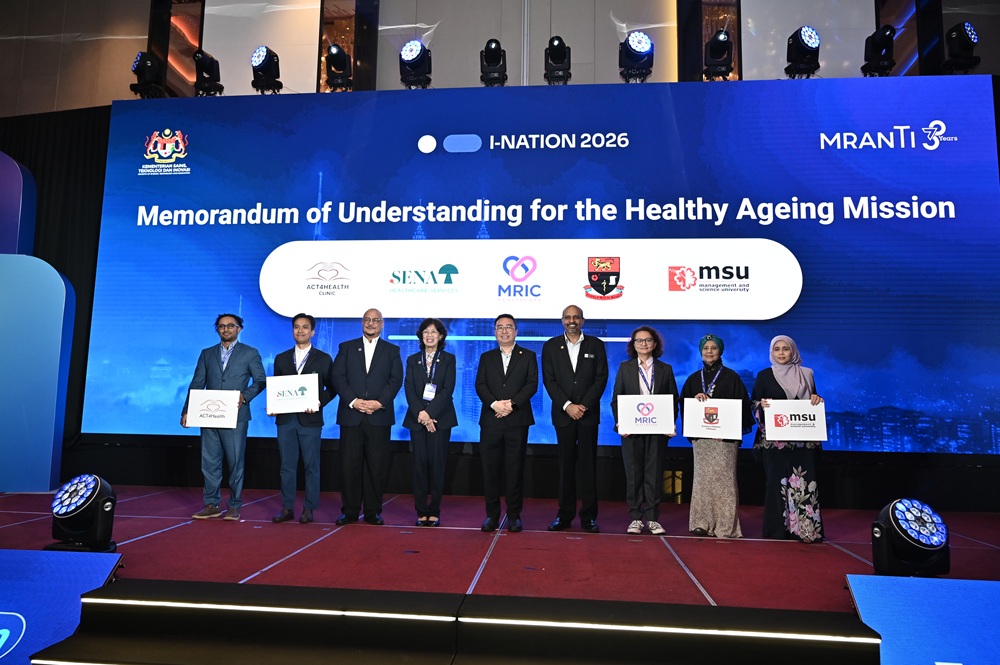
In the healthy ageing sector, MRANTI is finalising a collaboration agreement with MRIC Healthcare Sdn Bhd, identified as the mission’s first anchor partner.
The partnership aims to combine healthcare expertise and technological capabilities to develop practical pilot projects that address industry requirements.
During I-Nation 2026, MRIC Healthcare also exchanged memoranda of understanding (MoUs) with four strategic partners.
Its collaboration with the Academy of Medicine of Malaysia will focus on increasing awareness of liver cancer and improving access to screening and early diagnosis.

Meanwhile, its partnership with ACT4Health Senior Clinic Sdn Bhd will focus on community health screening and disease prevention, while its collaboration with Sena Healthcare will cover caregiver training and certification, as well as patient transportation and escort services for medical appointments.
MRIC Healthcare also signed an MoU with Management and Science University (MSU) to explore research into artificial intelligence (AI) applications in health sciences and the development of integrated medical applications.
Separately, plans are underway for MRIC Healthcare to enter into an MoU with CelcomDigi Mobile Sdn Bhd and CelcomDigi Telecommunications Sdn Bhd.
The proposed collaboration aims to support Malaysia’s healthy ageing agenda through the adoption of emerging technologies and innovative healthcare delivery approaches.
Another key component of the event was the Global Sandbox Forum (GSF), which brought together regulators, sandbox operators, industry representatives and international partners to strengthen cooperation in technology testing, validation and commercialisation.

Drawing on Malaysia’s experience through the National Technology and Innovation Sandbox (NTIS), the forum provided a platform to explore greater cross-border collaboration and accelerate the development and commercialisation of innovative technologies.
Through I-Nation 2026, MRANTI aims to strengthen collaboration between the public and private sectors while ensuring that research, innovation and technology development translate into tangible outcomes for Malaysia’s economy and society.





Leave a Reply