
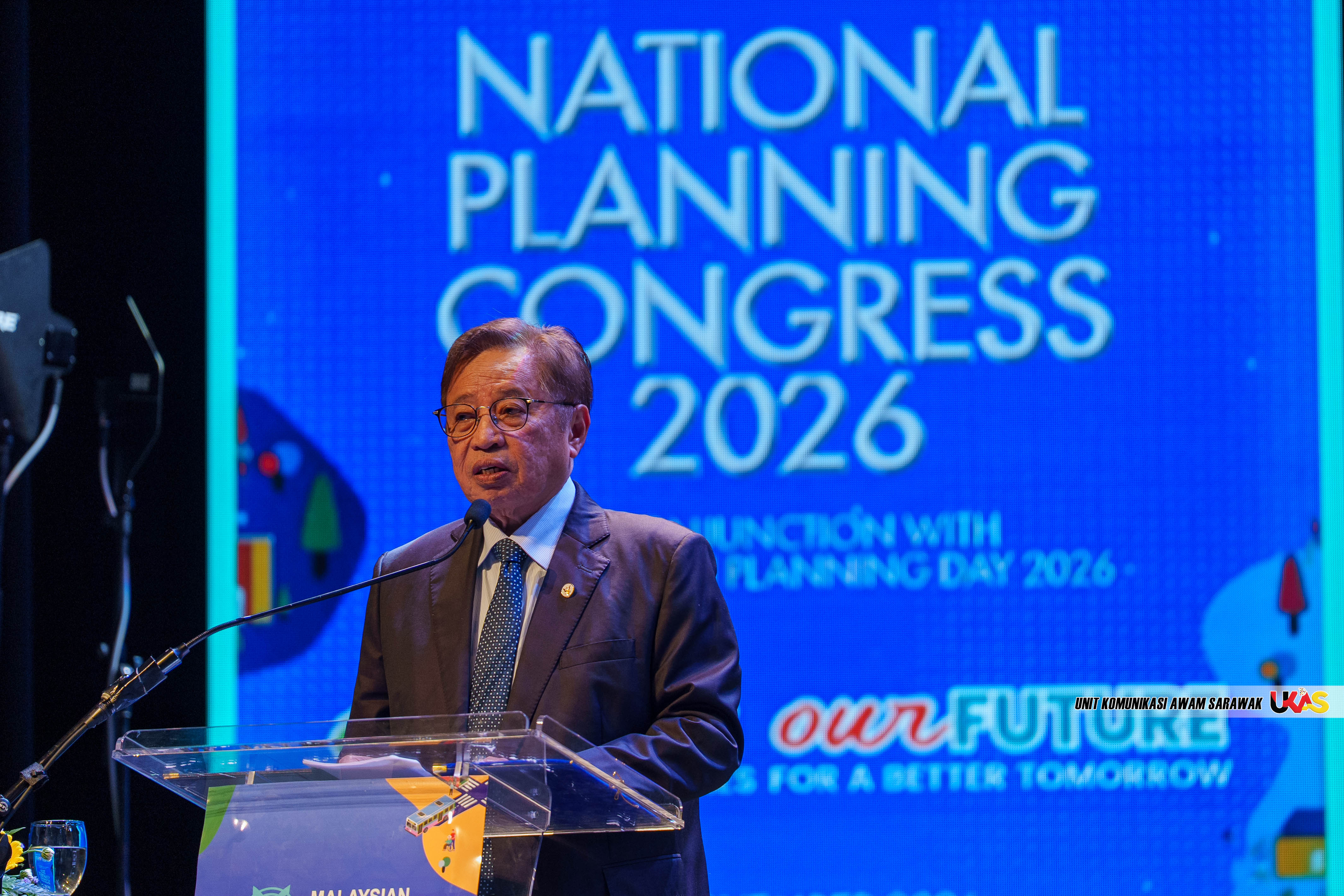
PETALING JAYA, Nov 5: Sarawak Premier Tan Sri Abang Johari Tun Openg has called for stronger collaboration between governments, local authorities, urban planners, developers and communities to build more sustainable, inclusive and resilient cities.
He said better cities could not be achieved through economic growth and infrastructure development alone, but required deliberate leadership, disciplined planning and shared responsibility across society.
Delivering the closing keynote address at the 11th National Planning Congress 2026 in Petaling Jaya today, Abang Johari said urban development must be guided by long-term public interests, social well-being and environmental sustainability.
Speaking on the theme, “Leadership for Better Cities: Our Shared Responsibility”, he stressed that the success of a city should not be measured merely by its buildings and roads, but by the quality of life it provides and the harmony it creates between people, institutions and nature.
Drawing on the philosophical thinking of 14th-century Muslim scholar Ibn Khaldun, he highlighted three important relationships underpinning responsible development: humanity’s relationship with God, fellow human beings and the environment.
He said these principles provided a moral compass for development, which must remain economically productive, socially just and environmentally responsible.
Abang Johari also emphasised the importance of integrated governance, saying disconnected decisions among planning authorities, land administrators, local governments, transport agencies and utility providers could result in unsatisfactory urban outcomes.
He said housing developments, for instance, must be planned alongside public transport, drainage systems, utilities and accessibility rather than being considered as isolated projects.
“Good governance is ultimately measured not by the number of plans produced or approvals issued, but by the quality of outcomes delivered to people,” he said.
Climate resilience and low-carbon development
On climate change, Abang Johari said cities must prepare for increasing challenges arising from extreme rainfall, flooding, rising temperatures and environmental degradation.
He called for climate resilience to be incorporated into planning decisions from the beginning, including better drainage management at catchment level and the protection of green and blue networks as essential infrastructure.
Sharing Sarawak’s initiatives, he highlighted the hydrogen-powered Autonomous Rapid Transit (ART) under the Kuching Urban Transportation System as part of the state’s efforts to develop cleaner public transportation.
He said the objective was not simply to introduce new technology but to improve connectivity, reduce congestion and make daily journeys to workplaces, schools and public facilities more convenient.
He also highlighted the importance of protecting Sarawak’s forests, wetlands and peatlands, noting that healthy peatland ecosystems played an important role in carbon storage, water regulation, biodiversity and climate resilience.
Sarawak was also moving towards Carbon Capture, Utilisation and Storage (CCUS) as part of its broader low-carbon development direction.
Affordable housing must remain a priority
On people-centric development, Abang Johari said affordable housing must be viewed as a leadership responsibility rather than merely a market concern.
He noted that housing affordability should not be determined by purchase prices alone, as accessibility to employment, public transport, schools and healthcare also affected the actual cost of living.
He cited the Sarawak Housing Contribution Trust Fund (SHCTF) as one of the policy mechanisms intended to strengthen shared responsibility in providing affordable housing.
“Affordable housing must never mean inferior housing. A home should provide security, dignity and the foundation for family life,” he said.
He added that communities must be consulted early in the planning process, as residents possessed valuable local knowledge about flooding, mobility, heritage, livelihoods and their everyday needs.
Green energy benefits must reach households
Abang Johari said Sarawak’s energy transition must deliver tangible benefits to ordinary households and not be confined to major industries and investors.
Under the state’s Post COVID-19 Development Strategy 2030, Sarawak is pursuing opportunities in renewable energy, hydrogen and other green industries.
He highlighted the state’s subsidy of up to RM12,000 for domestic rooftop solar installations, aimed at helping eligible households generate part of their electricity requirements and reduce monthly electricity expenses.
He said the effectiveness of the energy transition should be measured not only by renewable energy capacity installed but also by the actual benefits experienced by households.
AI and digital technology to support future-ready cities
On technology, Abang Johari said digital transformation, artificial intelligence (AI), geospatial information systems and urban analytics could significantly improve how cities were planned and managed.
These technologies could help authorities assess land suitability, infrastructure pressure, climate risks and development patterns more accurately.
However, he cautioned that a smart city was not automatically a sustainable city.
Technology must translate into better public services, safer mobility, improved flood-risk assessment, efficient infrastructure and stronger coordination between government agencies.
He also stressed the importance of cybersecurity, privacy safeguards, consistent standards and skilled professionals in supporting digital urban systems.
Abang Johari said investment in education, research and human capital was necessary to ensure young people were equipped not only to use emerging technologies but also to develop innovations that would shape future cities.
Sarawak’s long-term urban development direction
Sharing Sarawak’s development approach, he said the state was working towards balanced growth through the Post COVID-19 Development Strategy 2030, which placed economic prosperity, social inclusivity and environmental sustainability as mutually reinforcing objectives.
He identified Kuching, Sibu, Bintulu and Miri as important urban centres that should play complementary roles in providing services, employment and economic opportunities.
He also highlighted the proposed Sarawak Urban Development Policy 2050 as part of the state’s long-term approach to urban and settlement planning.
He said strategic planning must be translated into statutory plans, development decisions, infrastructure programmes and accountable delivery arrangements.
Ultimately, development must be experienced by the people through shorter journeys to work, better homes, reliable public services, safer neighbourhoods and more affordable household expenses.
In his closing remarks, Abang Johari called for a collective commitment from all stakeholders, stressing that no single institution could create better cities on its own.
He said governments must provide clear direction and protect public interests, local authorities must ensure effective service delivery, urban planners must provide professional advice, developers must take responsibility for long-term impacts, while communities must be given a meaningful voice.
He urged stakeholders to move away from fragmented initiatives towards shared priorities, coordinated implementation and measurable outcomes.
The 11th National Planning Congress 2026 was organised by the Malaysian Institute of Planners, bringing together stakeholders to discuss climate resilience, inclusive communities, future-ready technology, governance and the challenges of translating urban development visions into action.
Photo Credit – – UKAS (RAIZ)







Leave a Reply