
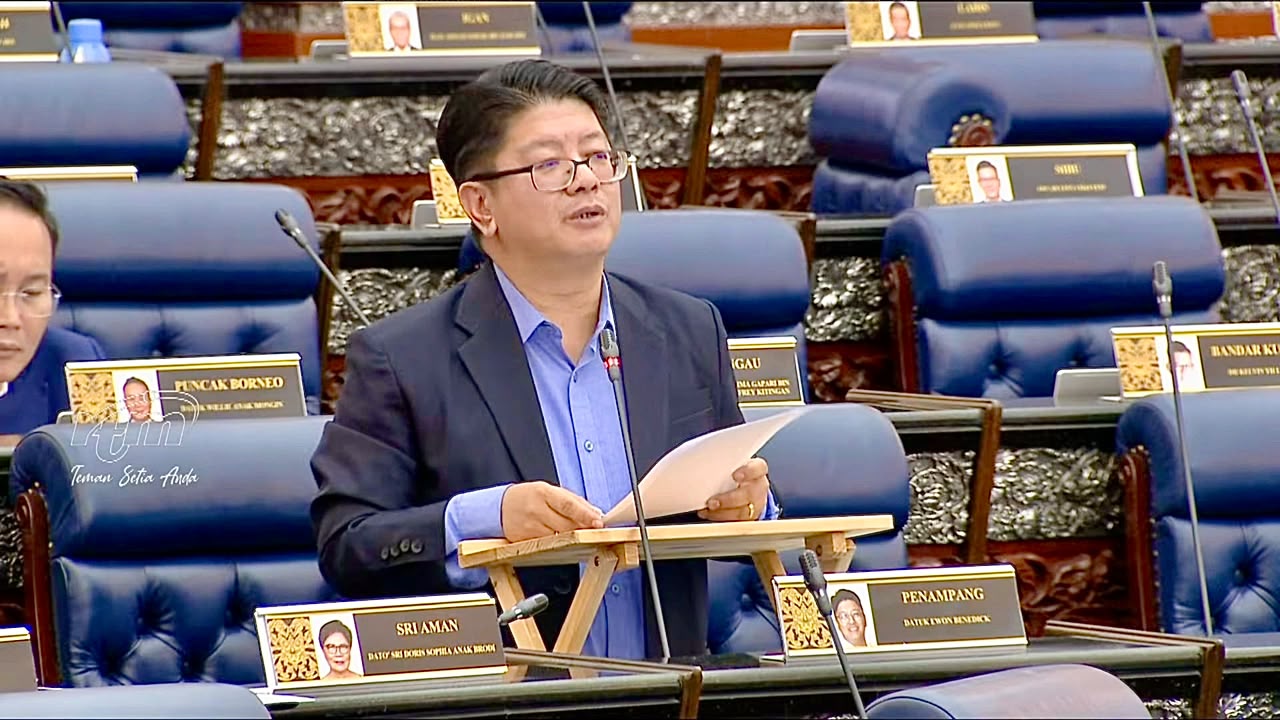
KUALA LUMPUR: Penampang Member of Parliament Datuk Ewon Benedick championed the Sabah First agenda during the Budget 2027 debate, highlighting Sabah’s constitutional rights, the implementation of the Malaysia Agreement 1963 (MA63), as well as the need to strengthen the state’s economic development and improve the well-being of its people.
He said the RM18.7 billion allocation for Sabah must translate into tangible benefits for the people, with its implementation taking into account the state’s unique geographical, logistical and historical circumstances.
“I appreciate the substantial budget allocated to Sabah. However, the true measure of its success will be whether the people of Sabah genuinely feel its impact,” he said during the policy-stage debate on Budget 2027 in the Dewan Rakyat two days ago.
On Sabah’s constitutional entitlement to 40 per cent of federal revenue derived from the state, Ewon proposed that payments be initiated based on collections by the Inland Revenue Board of Malaysia (LHDN) and the Royal Malaysian Customs Department (JKDM), while negotiations continue on revenue from other sources.
He said collections by the two agencies in Sabah amounted to RM7.547 billion in 2025, equivalent to RM3.019 billion for the 40 per cent entitlement.
In view of this, he proposed increasing the interim payment of RM1.5 billion to RM3.019 billion, stressing that the special payment would not constitute a final settlement of Sabah’s 40 per cent revenue entitlement claim.
Ewon also urged the country’s highest-level committee on MA63 implementation to convene and resolve five outstanding matters, including oil royalties, cash payments from petroleum, Sabah’s rights over the continental shelf and stamp duties.
He proposed that the five per cent share of petroleum cash payments currently paid by Petronas to the Federal Government be channelled to Sabah, in addition to the five per cent currently received by the state.
He further proposed that stamp duty revenue collected under the Sabah Land Ordinance be shared equally between the Federal Government and the Sabah Government.
On strengthening constitutional safeguards, Ewon stressed that Sabah and Sarawak should collectively hold at least one-third of the seats in Parliament. He also maintained that federal laws directly affecting Sabah should require the state’s consent.
On development implementation, he proposed that Sabah’s allocations be disbursed in the first quarter of the year, with procurement processes completed by the second quarter at the latest, to ensure projects can commence within the same year.
He also sought clarification on the cancellation of tenders for 40 out of 65 rural road projects in Sabah and proposed the establishment of a Special Budget Implementation Monitoring Committee in every state.
In the industrial sector, Ewon proposed that the Palm Oil Industrial Cluster (POIC) Lahad Datu be designated as a special economic zone under the Brunei Darussalam-Indonesia-Malaysia-Philippines East ASEAN Growth Area (BIMP-EAGA), positioning Sabah as Malaysia’s eastern gateway.
He also called for the expansion of business guarantee schemes to local companies seeking to grow their operations in Sabah’s industrial parks, including support for the halal industry.
“Micro, small and medium enterprises (MSMEs) in Sabah must be supported to scale up so that they can compete in capital markets and become more competitive across the region,” he said.
To improve access to assistance, he urged the expansion of entrepreneurship development agency offices to interior and underserved districts, including Keningau, Kota Marudu, Telupid and Beaufort.
In education and healthcare, Ewon called for dedicated allocations for mission schools. He also proposed a special policy to recruit medical students from Sabah into Universiti Malaysia Sabah, supported by sponsorships that require them to serve in the state upon graduation.
He further stressed that the Bumiputera economic agenda must encompass the interests of the Indigenous communities of Sabah and Sarawak, including support for customary land development and increased allocations for the Native Land Services Programme (PANTAS).
On religious freedom, he called for increased assistance for non-Muslim houses of worship and urged the government to tailor its guidelines to accommodate places of worship located on customary land or village reserves without individual land titles.
Ewon also reiterated his position that Federal Village Development and Security Committees (JPKK) in Sabah should be abolished. In addition, he called for federal support for Visit Sabah Year 2027 and the development of the state’s tourism industry.
He also proposed introducing voting mechanisms that would enable Malaysians working or studying outside their home states to exercise their voting rights without having to return to their places of origin.
Ewon expressed his support for Budget 2027, hoping that the proposals would be given due consideration through a “Domestic Look East Policy” approach to ensure that development policies and implementation better reflect the needs of Sabah and Sarawak.







Leave a Reply