
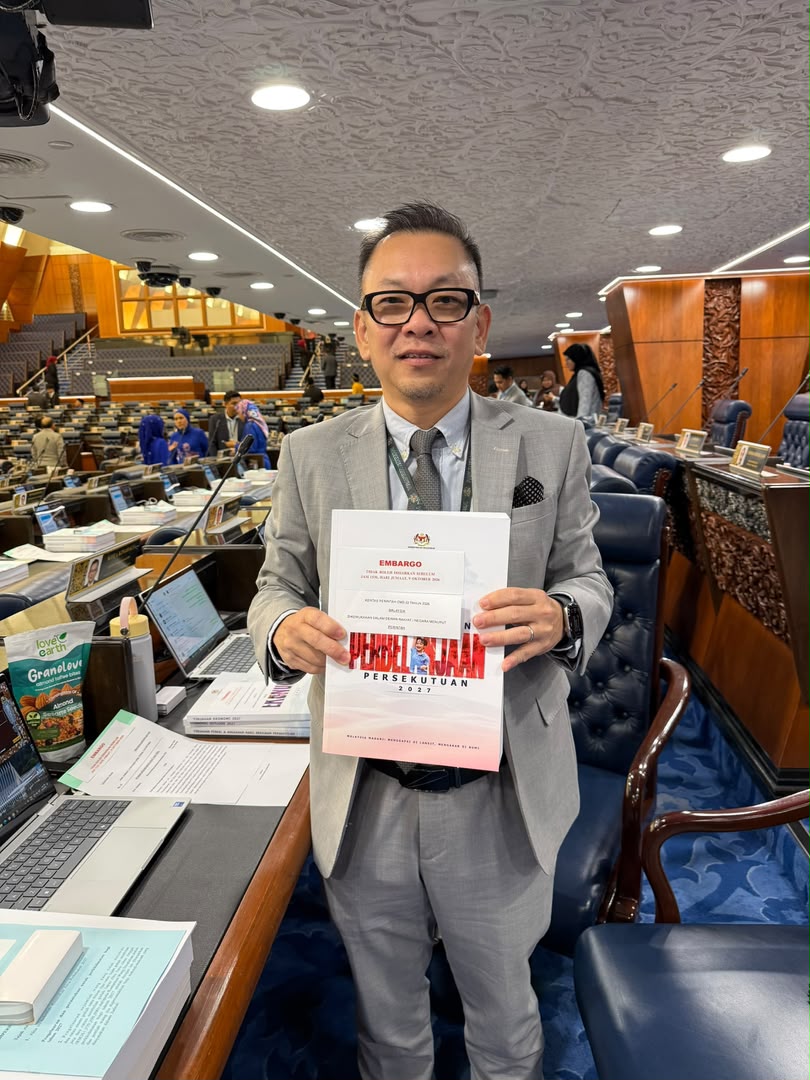
KUALA LUMPUR – Budget 2027 introduces measures to ease financial pressures on middle-income households, strengthen assistance for lower-income groups and expand housing, employment and skills development opportunities for young Malaysians, said DAP National Policy Director Datuk Chan Foong Hin.
Welcoming the measures, Chan said the budget represented a step towards a fairer economy by ensuring that the benefits of national development were shared more equitably across society.
For the M40 group, he highlighted the proposed increase in individual income tax relief from RM9,000 to RM12,000, alongside tax rate reductions for selected income brackets, as measures that could provide additional financial relief to working households.
He also welcomed the expansion of individual tax reliefs to cover a broader range of household expenses, including postpartum care services, care-related expenses for parents and grandparents, sports shoes, education across all fields of study and tuition fees for children.
Other expanded reliefs include AI software subscriptions, pet vaccination expenses and the cost of adopting pets from registered shelters.
Chan said the changes recognised the diverse financial responsibilities faced by families, from caring for ageing parents and raising children to investing in education and maintaining household well-being.
He stressed that middle-income households should not be overlooked as they continue to face rising living costs while having limited access to targeted financial assistance.
“Supporting the M40 is not merely about providing tax relief, but also about ensuring that working families can maintain a reasonable standard of living and build a more secure future,” he said.
For lower-income households, Chan highlighted the increased allocation of RM16 billion for Sumbangan Tunai Rahmah (STR) and Sumbangan Asas Rahmah (SARA), which is intended to strengthen assistance for eligible recipients.
The allocation for Jualan Rahmah MADANI and Jualan Agro MADANI will also rise from RM630 million to RM750 million, supporting 35,000 programmes nationwide to improve access to essential goods at more affordable prices.
On wages, Chan welcomed the planned increase in the minimum wage from RM1,700 to RM2,000 a month, effective June 2027. Micro, small and medium enterprises with annual sales revenue below RM50 million will be given time to adjust their business operations to accommodate the new rate.
He also described the proposed minimum starting salary of RM2,500 a month for graduates and semi-skilled workers as a positive step towards improving remuneration for skilled talent.
However, Chan said wage increases must be accompanied by productivity improvements to ensure Malaysia remains competitive without relying excessively on low labour costs.
He called for continued support for small and medium enterprises through automation, digitalisation, skills training and access to financing to help businesses adapt to higher wage requirements.
For young Malaysians, Budget 2027 includes nearly RM1 billion for housing initiatives such as Rumah Mesra Rakyat and Program Residensi Rakyat. Eligible first-time homebuyers will also benefit from stamp duty exemptions for their first homes priced at up to RM500,000.
Meanwhile, RM8 billion in allocations for technical and vocational education and training (TVET) across ministries will support skills development and employability.
The BAKAT MADANI initiative is also expected to target 30,000 new job opportunities in 2027, including through private-sector participation.
Chan said young people should have a fair opportunity to secure decent employment, purchase their first homes and build careers based on their abilities, regardless of their family backgrounds.
He added that skills development and job creation initiatives must translate into meaningful employment, competitive salaries and sustainable long-term career prospects.
Overall, Chan said Budget 2027 acknowledged the distinct challenges facing the M40, B40 and younger generation, but emphasised that effective implementation would be crucial to achieving its objectives.
He called for transparent monitoring and accountability to ensure that the announced allocations and initiatives deliver measurable benefits to households, workers and young Malaysians.







Leave a Reply