
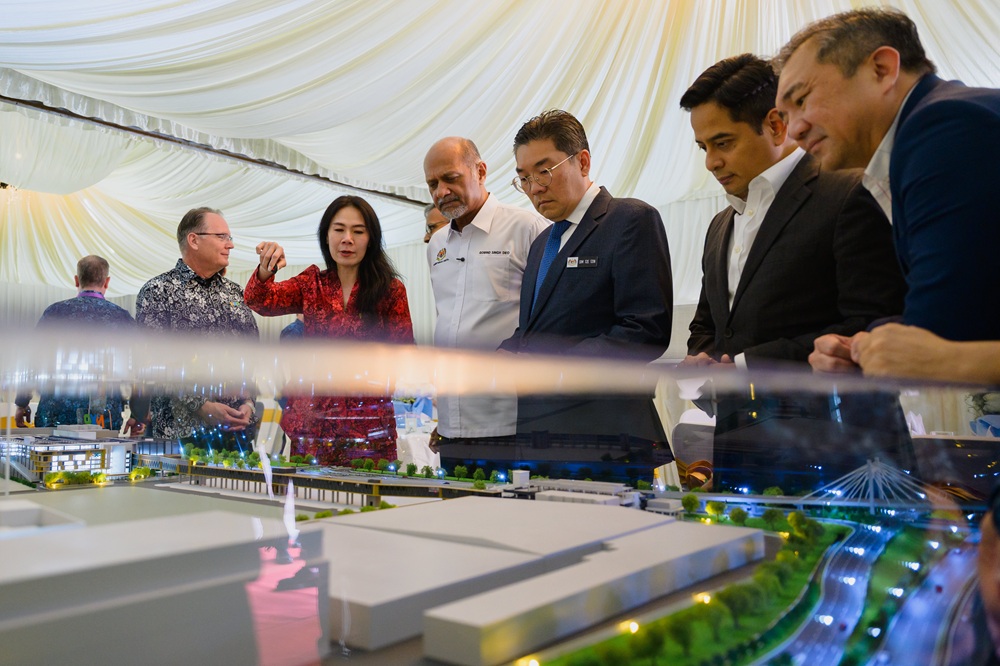
PETALING JAYA, Aug 12, 2026 — The groundbreaking ceremony for NXP Malaysia’s latest expansion in Petaling Jaya today points to a broader shift in Malaysia’s industrial landscape as the country seeks to attract more high-value investments and strengthen its position in the global semiconductor supply chain.
Rather than being simply another factory expansion, the NXP project reflects Malaysia’s growing ambition to move beyond traditional manufacturing and develop deeper capabilities in advanced technology, semiconductor engineering, automation and artificial intelligence.
The ceremony was attended by Netherlands Ambassador to Malaysia His Excellency Jacques Werner, Deputy Minister of Investment, Trade and Industry Sim Tze Tzin, Selangor Executive Councillor for Investment, Trade and Mobility Ng Sze Han, and Selangor Executive Councillor for Islamic Affairs and Innovation Culture Dr. Mohammad Fahmi Ngah.
Representing NXP were Executive Vice President and Chief Operations & Manufacturing Officer Andy Micallef and Managing Director and Vice President of NXP Malaysia Goon Ben Nee, alongside members of the company’s global and Malaysian leadership teams.
From manufacturing base to technology hub
Malaysia has long been an important player in the global semiconductor industry, particularly in assembly, testing and manufacturing.
However, the country is now attempting to move further up the value chain.
The government has placed increasing emphasis on attracting investments involving advanced manufacturing, integrated-circuit design, advanced packaging, artificial intelligence hardware and other technology-intensive activities.
The NXP expansion comes at an important time in that transition.
Malaysia recorded RM92.8 billion in approved investments in the first quarter of 2026, with Selangor recording the largest share among the states. Foreign investments accounted for RM56.2 billion, or 60.5 per cent, of the total.
The figures underline continued international interest in Malaysia as companies look for competitive, resilient and strategically located manufacturing bases.
The real competition is talent
While capital and infrastructure remain important, the development of skilled talent is increasingly becoming the deciding factor in attracting and retaining advanced technology investments.
This was one of the key themes highlighted during the NXP ceremony.
NXP’s collaboration with Universiti Malaya, Universiti Putra Malaysia and Monash University Malaysia was cited as an important example of industry-academia cooperation.
The company was encouraged to deepen these partnerships and create more opportunities for students, graduates and existing employees to develop skills in semiconductor engineering, automation, artificial intelligence and smart manufacturing.
For Malaysia, the objective is clear: foreign investment should not only create jobs, but also help build a stronger pool of local expertise.
The next generation of Malaysian engineers, technicians and technology professionals will determine whether the country can successfully move from being a major manufacturing location to becoming a more complete technology ecosystem.
Why Selangor matters
The expansion is also significant for Selangor, which continues to attract major investments across manufacturing, technology, logistics and other high-value industries.
Petaling Jaya, in particular, has long been associated with Malaysia’s industrial and commercial development.
The presence and expansion of established multinational technology companies reinforces Selangor’s role as an important link between Malaysia’s industrial capabilities, skilled workforce and international investment networks.
For the state, the challenge now is to ensure that new investments create wider economic benefits — from employment and skills development to opportunities for local suppliers, service providers and technology companies.
A stronger Malaysia-Netherlands partnership
The presence of the Dutch ambassador at the event also highlighted the international dimension of the investment.
Malaysia and the Netherlands have maintained longstanding economic and diplomatic relations, with both countries having interests in trade, investment, technology and sustainable development.
At a time when global companies are reassessing supply chains because of geopolitical uncertainty, stronger partnerships between countries such as Malaysia and the Netherlands are becoming increasingly important.
The semiconductor industry is particularly sensitive to supply-chain disruptions because modern electronics depend on complex networks spanning multiple countries.
Malaysia’s ability to provide a stable business environment, established infrastructure and an experienced semiconductor workforce gives it an opportunity to strengthen its role in this increasingly strategic industry.
Beyond the investment numbers
The significance of NXP’s expansion ultimately goes beyond the value of the investment itself.
The bigger question is what Malaysia can gain from such projects in terms of knowledge, technology, talent and long-term industrial capability.
Malaysia wants companies operating in the country to increasingly undertake higher-value activities and contribute to the development of local capabilities.
That means stronger cooperation between multinational companies, universities, research institutions, government agencies and Malaysian businesses.
NXP’s existing engagement with Malaysian universities provides a foundation for such cooperation.
If expanded further, these partnerships could help create a stronger pipeline of engineers and technology professionals equipped for the demands of advanced manufacturing.
A test of Malaysia’s next phase
The NXP expansion arrives at a critical stage in Malaysia’s economic development.
The country has already established itself as an important semiconductor manufacturing centre. The next challenge is to ensure that this foundation can support a more sophisticated technology ecosystem.
That will require sustained investment in education, research and development, infrastructure, digital capabilities and skilled talent.
It will also require closer cooperation between government and industry.
The groundbreaking ceremony in Petaling Jaya therefore represents more than the start of another construction project.
It is a signal that established global technology companies continue to see value in Malaysia — and a reminder that Malaysia’s next phase of growth will depend increasingly on its ability to convert investment into innovation, skills, technology and higher-value economic activity.
For NXP, the expansion strengthens its presence in Malaysia.
For Selangor, it reinforces the state’s attractiveness to technology-intensive investors.
And for Malaysia, it offers another opportunity to demonstrate that the country can evolve from a manufacturing destination into a more advanced, resilient and globally competitive technology economy.





Leave a Reply